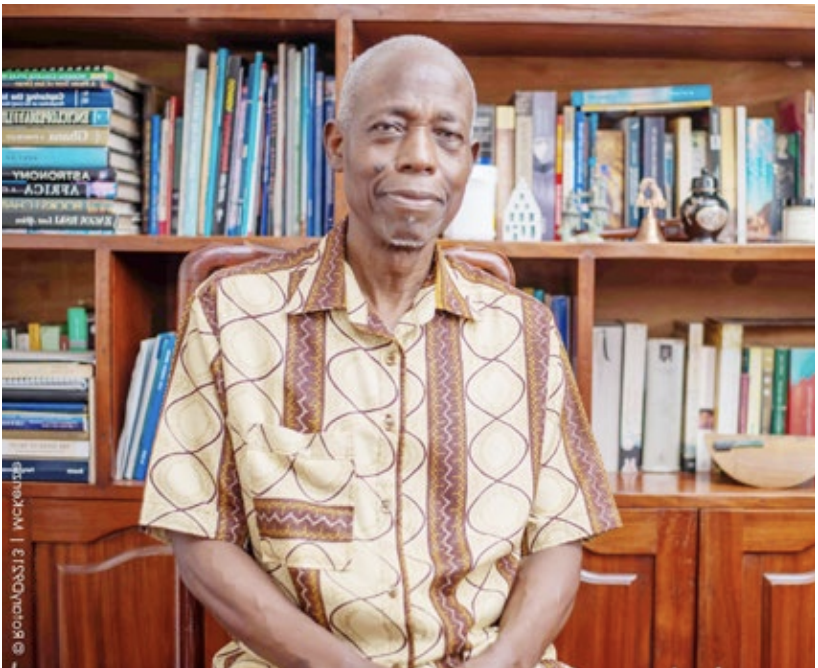
On October 15, District Governor Geoffrey Martin Kitakule announced the appointment of Past District Governor Francis “Tusu” Tusubira as a Trustee of The Rotary Foundation to serve a four-year term from July 1, 2026, to June 30, 2030. Rtns. Sheila Naturinda & Mark Asiimwe, caught up with him for an engaging conversation.
Who are Trustees of Rotary International?
The Board of Trustees manages the affairs of The Rotary Foundation, which is the charitable arm of Rotary International, responsible for funding service activities around the world. The Rotary International President-Elect nominates candidates for the Board of Trustees, who are then elected by the Rotary International Board of Directors to serve four-year terms.
Legally called The Rotary Foundation of Rotary International, the Foundation is owned by Rotary International but operates independently. It manages all charitable funding and related activities, while sharing staff and premises with Rotary International; but the costs and time is fairly allocated. Its leadership includes a Chair, Vice Chair, and Trustees, and it oversees grants, the Endowment Fund, PolioPlus, and other community programs.
While the RI Board of Directors is the overall governing body, the Board of Trustees operates independently once appointed. Coordination is maintained through designated liaisons from each board to ensure alignment and communication. The Trustees oversee the Foundation’s investments, programs, and charitable operations, reporting to the RI Board. Their relationship mirrors that of separate branches of government—where Trustees, though appointed by the Board, function autonomously within an established framework.
What has inspired your service to reach at this level- from an ordinary Rotarian, to a President and other roles, to a Governor and now a Trustee?
I will say this; may be i am not an ordinary Rotarian. And who really, is a Rotarian? To me, it is someone who goes beyond membership to fully live the Rotary experience.
Think of it like joining a university, you don’t become a graduate until you’ve completed the full course for which you were admitted. In the same way, being a Rotarian requires one to take the trouble to understand Rotary deeply; what it stands for, what it demands, and the joy it brings when lived out in service. A true Rotarian studies, practices, and embodies Rotary’s ideals. Perhaps today, the term Rotarian is sometimes used too loosely; if it were applied in its truest sense, our collective image would always reflect Rotary’s highest values.
So, what exactly will Tusu be doing?
I will be part of the team handling these responsibilities, though I have not yet received formal training, so I may not fully grasp all the rules. I know, however, that the Rotary Code of Policies and Rotary Foundation Code of Policies, together with Trustee decisions and priorities, provide essential guidance.
From an African perspective, one key focus should be helping people understand what and why Rotary and what and why the Rotary Foundation. When members grasp this, it becomes easier to serve effectively and avoid unnecessary disruptions.
Secondly, as was once said, “a good Rotarian is an informed Rotarian.” We need to reinvest in educating members about Rotary’s purpose rather than chasing numbers alone. Membership growth is important, but quality matters more. Many leave because they don’t deeply understand Rotary. This aligns with the thinking of RI President-Elect Yinka Babalola and Director Emmanuel Katongole, emphasizing learning among both Rotarians and Rotaractors to achieve meaningful service.
Equally, we must balance membership quantity with quality, as strong members drive both impact and giving. Many of our members spend more on social events than contributing to The Rotary Foundation, not out of unwillingness, but because they haven’t been helped to understand why they should give.
Finally, strengthening international collaboration remains vital for successful service projects, though these are my initial views as I await training.
Is this a paid “big job” 😀?
This is very interesting. We all know that Rotary is the only place where you pay to serve. I know there is no paid job outside the staff of Rotary International and Rotary Foundation. The only expenses covered are for mandatory meetings where travel is facilitated; but not in the Ugandan sense of receiving allowances. That doesn’t happen in Rotary because some of your duties can be costly in terms of journeys, so they support just like they support the Governors to move around their district.
How can we; the ordinary Rotarians contribute meaningfully to your job and vision?
I think we can collectively contribute to the success of the mission of the Rotary Foundation. Our focus should never be on advancing an individual, such as Tusu, but on strengthening the organization itself. If our efforts begin to centre on personalities rather than purpose, then something is amiss.
From my experience serving the church, in the synod, on the diocesan board, and even representing the bishop on the provincial board of education, in all that i found people with many human weaknesses like we all have. Just as one cannot dismiss the church because of a disagreement with a single clergyman, we must not lose sight of what Rotary truly stands for.
When we focus too much on who holds a position, we risk losing the essence of Rotary’s story line.
As Rotarians, we all have a responsibility to support the Rotary Foundation; the heart of Rotary’s work, to advance world peace, understanding, and goodwill. The question, then, is how do we do it? Rotary defines two principal ways to support the Foundation:
- By developing and implementing effective service projects that create lasting impact in our communities and beyond.
- By giving, donating financially to sustain the Rotary Foundation’s programs and global initiatives.
These two avenues of support are at the very core of Rotary membership. From the moment one becomes a Rotarian, the call to serve and to give becomes both a privilege and a shared commitment to doing good in the world.
Of course, Rotary’s flagship program stands apart; a solemn promise to the people and children of the world: to end the crippling disease, Polio. Until polio is completely eradicated, and knowing it can resurge at any time, our commitment must remain unwavering.
So, when asked how one can support any Trustee not me in particular, my answer is simple: by showing that we are developing and implementing effective service projects, we are giving to the Rotary Foundation, and we are supporting the global fight to end polio.
Now that the Trustee is “Ours,” what shall change for our District?
Think about Yinka [Olayinka Hakeem Babalola-RIPE], Emmanuel (Katongole-Director Elect) and the rest of us; all from the African continent. It’s quite unusual to have such a high concentration of leaders from within Africa, which of course means that in one sense it is happening because Rotary in Africa is performing exceptionally well; on the other, it presents a challenge.
When I speak to clubs aspiring to have a Governor, I often tell that that if you become a Governor while your club is collapsing, you lose the moral authority to speak anywhere. Your jurisdiction may be the entire district, but if, say, 30% of your club members haven’t paid RI dues, can you really stand with authority?
That’s the same challenge my colleagues; President-elect Yinka [Olayinka Hakeem Babalola-RIPE], Emmanuel [Katongole], and I are going to face. Our assignments will not just be within our zone but across the world. And people will first look at where we come from before believing our message.
So, fellow Rotarians, if you want to be visible and take pride in people who have gone a step where they can have global impact, they are going to work a lot more and become a lot better. That is very real, because we need to walk with pride so that when you go to the convention, you can say with confidence, “I am from Uganda,” not because you have an RI Director from there, but because Uganda is doing so well and its performance speaks for itself. That, to me, is what it means to say “we are in things.”
If you could describe The Rotary Foundation of Rotary International as a person, what kind of personality would you give him, and why?
As a person, he would be a loving, very serious, with a clear purpose. He would be a person whose head is fully functioning, of decent character, loving his children and in need of doing something great for them but when he is immobile, chair ridden or bed ridden and all he can do is to wish all these good things to happen around the world. That is how i see the Rotary Foundation, and that is why it needs this tremendous resource of people who can understand that passion and vision and share it, so that they can then do what this immobile person wants to do.
It would also have that personality of an endless giver. Giving is a wonderful thing, but it’s also where we often go wrong. We’re burning out Rotarians. One key training area we need to emphasize is developing the confidence to go out to the people and ask for money, and fundraise, not for us and them, but for a something good.
If you went to a big businessman in town and asked them to donate $50,000, then you could get this kind of fund which you will direct where it goes. That a fund is named after you, but more importantly you can determine where you want the proceeds of that fund in perpetuity to go whether by location in a district, area of focus, or even scholarships and so much more. So, i think we need to learn a lot more about looking for money outside of Rotary.
We need to learn more from outside Rotary and do things differently. When one club does something good, everyone rushes to copy it, even when it doesn’t fit their context. One club raises 10 million shillings from a bank, and suddenly every other club is running to the same institution!
Have u ever asked why many corporate companies support the Rotary Cancer Run? Because it offers visibility. That’s the secret. We need to teach our clubs how to develop creative, sustainable fundraising avenues; the kind that make Rotary live. It’s time we stop focusing inward but we can rely on others to sustain our Foundation, rather than depending on our own growth and internal strength.
How can we grow major gifts/endowment locally and recognize donors well?
If you leave an endowment to your children or your family, what does it mean? In Uganda the problem is the family could decimate all you have left- so many people set up a Trust to ensure the continuity of your businesses — that is what we call an Endowment Fund.
In Rotary, the Trust manages the endowment fund for the benefit of the Rotarians who are doing service projects. So, the endowment fund is never spent- it is simply invested so that there is a sustainable source of income which keeps operations in terms of doing work of the Foundation going, and that’s why that target of $2Bn was set long ago and we have now exceeded it. That’s the essence of the endowment fund.
When you give to it, you are saying, “I’m contributing to this fund so it can continue doing good in the world.” But you can also set up an individual endowment under The Rotary Foundation; which will be a sum of money that meets minimum thresholds that above this level, it is recognized in your name; and you can even dedicate it to a specific cause. The endowment fund is designed so that the principal is invested in perpetuity and only a portion of earnings is spent, so that your gift contributes to long-term sustainability
In essence, one can choose to leave funds with The Rotary Foundation to support causes like Basic Education and Literacy in Uganda. When asked why the money should remain with the Foundation, the answer lies in Rotary’s proven integrity, its global systems ensure prudent management, strategic investment, and transparent collaboration. Rotary acts as a trustworthy custodian, guaranteeing that contributions are not only safeguarded but also multiplied in impact. Each year, the proceeds from such funds are communicated to districts and clubs, indicating the available resources for matching grants in specific focus areas as determined by the donor’s intent.
This is the kind of knowledge we must keep talking about, because many people are not aware. We focus too much on recognition that we forget the why of giving. And that’s why some people eventually stop giving because once you truly understand the reason and purpose for giving, and have seen the impact, you can’t stop giving; it becomes part of who you are.
When you are not wearing the Trustee hat, what will a perfect Rotary-free day look like for you?
My life always starts with Family, and God always at the centre if it all but family is a priority to me. We engage a lot with working with the youths- mentoring and working with our communities. We have work in Namalimba we do- in Bugweri district.